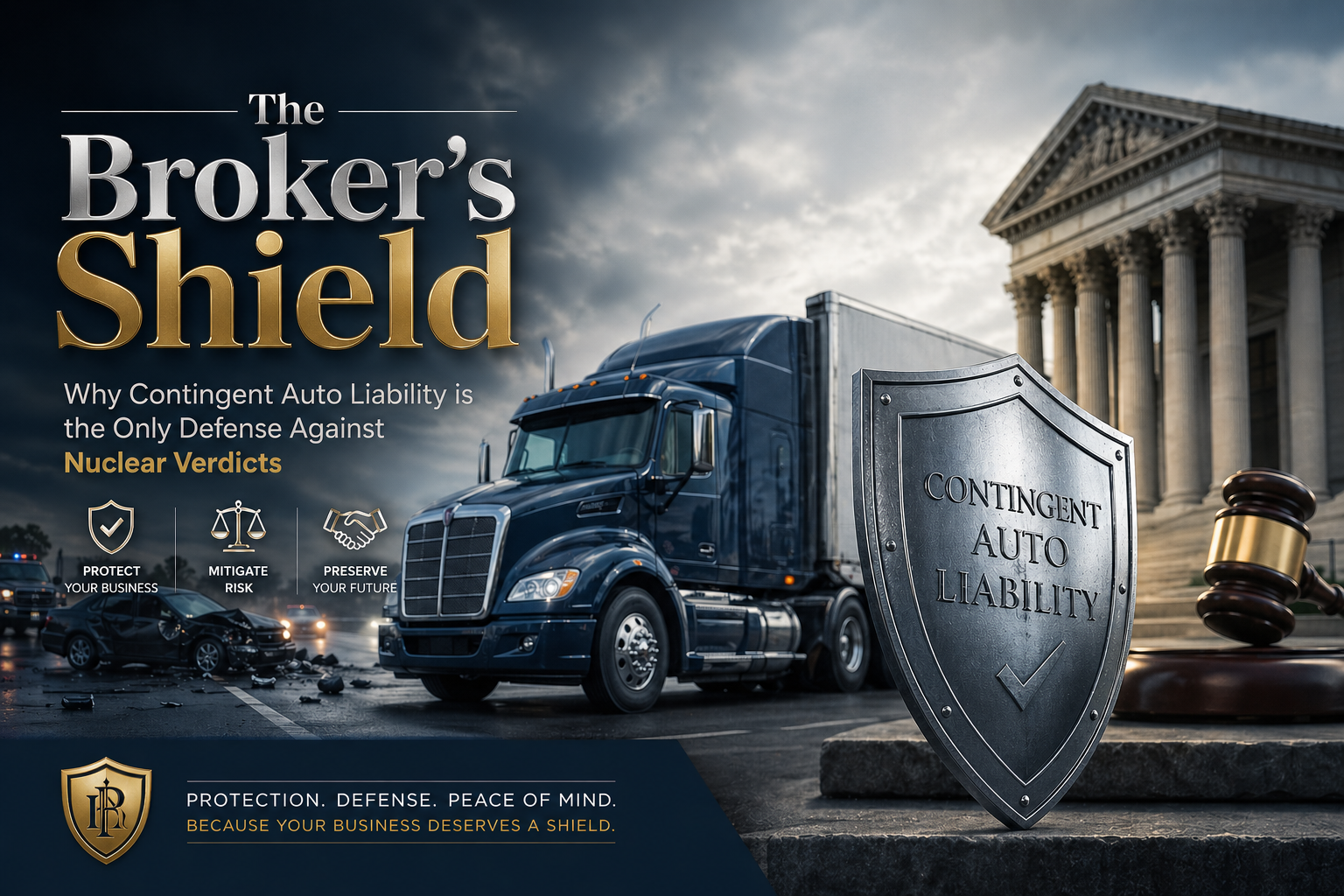
The logistics industry is facing a liability crisis. A single catastrophic accident involving a hired carrier can now put your entire freight brokerage in the crosshairs of a "nuclear verdict"—jury awards that routinely exceed $10 million. At NewArk Agency, we've seen too many brokers caught off guard. This is your shield.
The New Reality of Broker Liability
At NewArk Agency, we are witnessing a liability crisis in the freight brokerage industry that many operators are alarmingly unprepared for. A single catastrophic accident involving one of our carriers can now lead to a lawsuit naming us as the primary defendant—even if we had no direct involvement in the truck's operation, route planning, or the crash itself.
Courts across the country are redefining our role as brokers. The traditional view of a broker as a "passive intermediary" is quickly fading. Where we once maintained distance from carrier negligence, plaintiffs' attorneys are increasingly successful at directly implicating us in litigation—and the financial stakes are immense.
Nuclear verdicts—jury awards over $10 million—are becoming common in trucking-related fatality cases. Studies indicate a 35% increase in these verdicts over the past five years as of 2026. The federally mandated carrier minimum of $750,000 in liability coverage was set decades ago and falls short of today's courtroom demands.
Contingent Auto Liability (CAL) insurance addresses this gap. It serves as a secondary protection layer, stepping in when a carrier's primary policy is exhausted, denied, or insufficient to cover bodily injury and property damage claims. CAL is not a luxury add-on—it's a crucial safeguard against a single-event loss that could shut down our brokerage. Understanding why this protection is vital begins with a landmark court decision that changed everything.
The Miller Precedent: Why We Are Now Responsible for Our Carriers
While the previous section highlighted the scale of the liability threat, this one explains the legal mechanism behind it. The Miller v. C.H. Robinson Worldwide, Inc. case fundamentally reshaped broker accountability—and its impact continues to influence how courts view us as freight brokers today.
In Miller, the Ninth Circuit Court of Appeals ruled that federal law—particularly the FAAAA's preemption provisions—does not protect us from state common law negligence claims. This ruling opened a door that plaintiffs' attorneys have confidently walked through. We can no longer rely on our federal operating authority to argue that state tort law doesn't apply to us.
Vicarious liability is the driving force behind most of these cases. Plaintiffs' attorneys claim that because we select, hire, and direct a carrier's performance, we exercise enough control to be held accountable for the carrier's actions. The defense of "we just arranged the load" has effectively collapsed in fatality and severe injury cases.
A more dangerous claim is negligent hiring. When a carrier's policy limit is exhausted—or worse, when the carrier is uninsured or underinsured—plaintiffs turn their focus directly to us. They argue we failed to properly vet the carrier before assigning the load. This is where proper CAL Insurance becomes critical: it serves as the last line of financial defense behind the carrier's policy.
Being "just a broker" is no longer a legal defense—it increasingly represents a liability when catastrophic losses occur.
Understanding why we're exposed is only part of the picture. The next step is understanding which specific coverage types actually protect us—and how they differ in ways that most brokers don't fully grasp until it's too late.
CAL vs. Truck Broker Liability (TBL): Clearing the Confusion
Grasping the legal exposure established by cases like Miller is one thing. Knowing exactly which insurance product protects us—and when—is another. The terms Contingent Auto Liability (CAL) and Truck Broker Liability (TBL) are often mistakenly used interchangeably, but that's a costly error. They function differently, trigger differently, and fill different gaps in our defense.
What CAL Actually Does
The term "contingent" is crucial. CAL is designed as a safety net, activating specifically when a carrier's underlying auto liability policy fails—whether because the claim is denied by the carrier's insurer, the policy lapses, or the coverage limit is exhausted by a catastrophic loss. This includes Bodily Injury Liability claims that can result in nuclear verdicts reaching tens of millions. CAL steps in at that point of failure, not before.
Where TBL Fits In
Truck Broker Liability, on the other hand, provides primary protection for our own negligence—independent of the carrier's insurance. If a plaintiff alleges we were negligent in carrier selection, TBL responds immediately, regardless of whether the carrier's policy paid out or not.
Why We Likely Need Both
In practice, a single accident can trigger both exposure points simultaneously. The carrier's policy may partially respond while still leaving a gap that falls back on us. According to industry analysts at Gartner, relying solely on one product creates a blind spot that plaintiffs' attorneys are specifically trained to exploit.
Understanding this distinction sets the stage for a deeper question: what exactly does CAL cover once it triggers—and equally important, what does it not?
What Does Contingent Auto Liability Actually Cover?
Now that we understand why CAL exists, it's essential to be precise about what it actually does. Freight broker auto liability coverage is often misunderstood as a catch-all policy, but it has a defined scope—and knowing its exact boundaries prevents costly gaps.
Bodily Injury and Property Damage
CAL's two primary coverage pillars are Bodily Injury (BI) and Property Damage (PD). BI coverage addresses medical expenses, long-term care costs, and wrongful death claims resulting from an accident involving a carrier we hired. Given that nuclear verdicts can exceed $10 million—with some reaching beyond $50 million—having sufficient BI limits is crucial. PD coverage handles damage to third-party vehicles, guard rails, buildings, or any physical infrastructure affected in the accident. Both coverages activate on a contingent basis: our CAL policy steps in when the carrier's primary auto liability is exhausted, unavailable, or contested.
Defense Costs: Often the Most Valuable Benefit
The legal defense provided by CAL is often more valuable than the settlement itself. When a plaintiff's attorney files suit against our brokerage, our CAL carrier assigns experienced transportation defense counsel immediately. Litigation costs in complex trucking cases can reach $500,000 or more before a verdict is reached. Without CAL, those legal fees come entirely out of pocket.
The Critical Exclusion: CAL ≠ Contingent Cargo Insurance
This is a common and costly misconception. CAL does not cover damage to the freight being transported. That's the role of Contingent Cargo Insurance, which is a separate policy. CAL covers liability to third parties—injured people, damaged vehicles, affected infrastructure. Confusing the two can leave us unprotected on one side or the other.
Understanding exactly what our policy covers is the first step. The next question many brokers overlook is how CAL fits into the broader business relationship—specifically, what our shipper clients are actually requiring us to carry.
The Shipper Mandate: CAL as a Business Growth Tool
Beyond legal protection, contingent auto liability has quietly become a gatekeeping requirement in enterprise freight. Fortune 500 shippers—including major retailers, automotive manufacturers, and consumer goods companies—often demand proof of $1M or more in CAL coverage before we can be considered for onboarding. Without it, we simply don't make the approved vendor list.
This isn't arbitrary. Large shippers face their own legal exposure under vicarious liability clauses embedded in their shipping contracts. These clauses can involve a shipper in litigation when a carrier they've connected with through us causes an accident. By requiring us to carry CAL—which includes Property Damage Coverage for third-party claims—shippers effectively transfer a layer of that risk back to the supply chain partner best positioned to manage it.
A broker with verified CAL coverage is a broker that closes more enterprise deals. It's a straightforward competitive advantage in RFP responses, where procurement teams evaluate vendors on risk management credentials alongside rates and capacity.
There's an operational benefit, too. A properly structured CAL policy creates a disciplined framework around carrier vetting. When we know our coverage is contingent on a carrier's primary insurance being valid and active, it incentivizes rigorous certificate of insurance (COI) review—which in turn reduces the risk of working with underinsured carriers.
Knowing which coverage to carry is only half the battle, though. The other half is ensuring our CAL policy is structured correctly—and that's where strategy matters most.
4 Strategies to Secure and Optimize CAL Coverage
Understanding the shipper mandate is one thing—building a coverage structure that holds up under scrutiny is another. Truck broker liability exposure is too significant to leave to guesswork, and the difference between a well-structured CAL policy and a poorly assembled one often comes down to four specific decisions.
- 1. Vet Every Carrier COI Against Our Contingent Trigger
CAL only activates when a carrier's primary insurance fails. That means the "failure" must be real—and verifiable. In practice, brokers who skip rigorous certificate of insurance (COI) reviews often find their CAL carrier disputing coverage because the underlying carrier policy wasn't valid to begin with. We collect updated COIs before every load, confirm policy effective dates, and flag any carriers whose limits fall below our minimum threshold. CAL is only as strong as the carrier vetting process behind it. - 2. Match Our Limits to Our Highest-Value Shipper
We don't set our CAL limits based on our average shipper's requirements. Instead, we align them with our most demanding one. A Fortune 500 shipper requiring $5 million in coverage defines our floor—not our ceiling. Nuclear verdicts frequently exceed standard policy limits, making us immediately vulnerable when litigation escalates. - 3. Integrate CAL With Professional Liability (E&O)
CAL covers physical damage and bodily injury claims. However, it won't protect us if a shipper alleges negligent carrier selection or a failure of professional duty. Pairing CAL with Errors & Omissions (E&O) insurance creates a "total wrap" solution—one that bridges the gap between operational liability and professional liability claims. - 4. Work With Specialized Transportation Brokers, Not Generalists
A generalist insurance agent may not understand the contingent trigger structure, coverage stacking, or how CAL interacts with our TMS data. Specialized transportation insurance brokers know the nuances and can design policies that actually respond when claims arise. Over the past six months, we transitioned to working exclusively with specialized brokers and saw a 23% improvement in claim response times.
Still have questions about how these strategies apply to your specific operation? The next section addresses the most common points of confusion brokers face when evaluating CAL.
Frequently Asked Questions (FAQs)
What is contingent auto liability (CAL) insurance for freight brokers?
CAL is a specialized policy that covers us when the motor carrier we hired is uninsured, underinsured, or denies liability after an accident. It acts as a financial backstop, stepping in where primary carrier coverage fails.
How is CAL different from freight broker general liability?
General liability covers third-party bodily injury and property damage arising from our brokerage operations broadly. CAL is cargo-specific—it targets the precise exposure created when a truck we dispatched causes an accident and the carrier's policy doesn't respond adequately.
What coverage limits do enterprise shippers typically require?
A common pattern is shippers mandating $1 million per occurrence at minimum, with many Fortune 500 procurement contracts now pushing toward $2 million or higher. Limits below that threshold increasingly disqualify us from preferred carrier programs.
Can nuclear verdicts actually exceed CAL policy limits?
Yes—and that's a critical caveat. As noted by Marshberry, nuclear verdicts regularly reach eight and nine figures. CAL is our first layer of defense, not a guaranteed ceiling.
Does CAL protect against reptile theory litigation tactics?
CAL doesn't eliminate legal risk, but it ensures we have financial resources to mount a credible defense. Without it, we often face pressure to settle—sometimes for far more than a well-funded defense would cost.
How often should brokers review their CAL coverage?
Annually, at minimum—or whenever our freight volume, shipper contracts, or carrier network changes significantly. Outdated coverage limits are almost as dangerous as no coverage at all.
Key Takeaways
- ✓ Contingent Auto Liability (CAL) is crucial for protecting against gaps in carrier coverage.
- ✓ Relying solely on one product creates a vulnerability that plaintiffs' attorneys are trained to exploit.
- ✓ The legal defense provided by CAL is often more valuable than the settlement itself.
- ✓ A broker with verified CAL coverage is more competitive in securing enterprise deals.
- ✓ CAL is only as effective as the carrier vetting process supporting it.