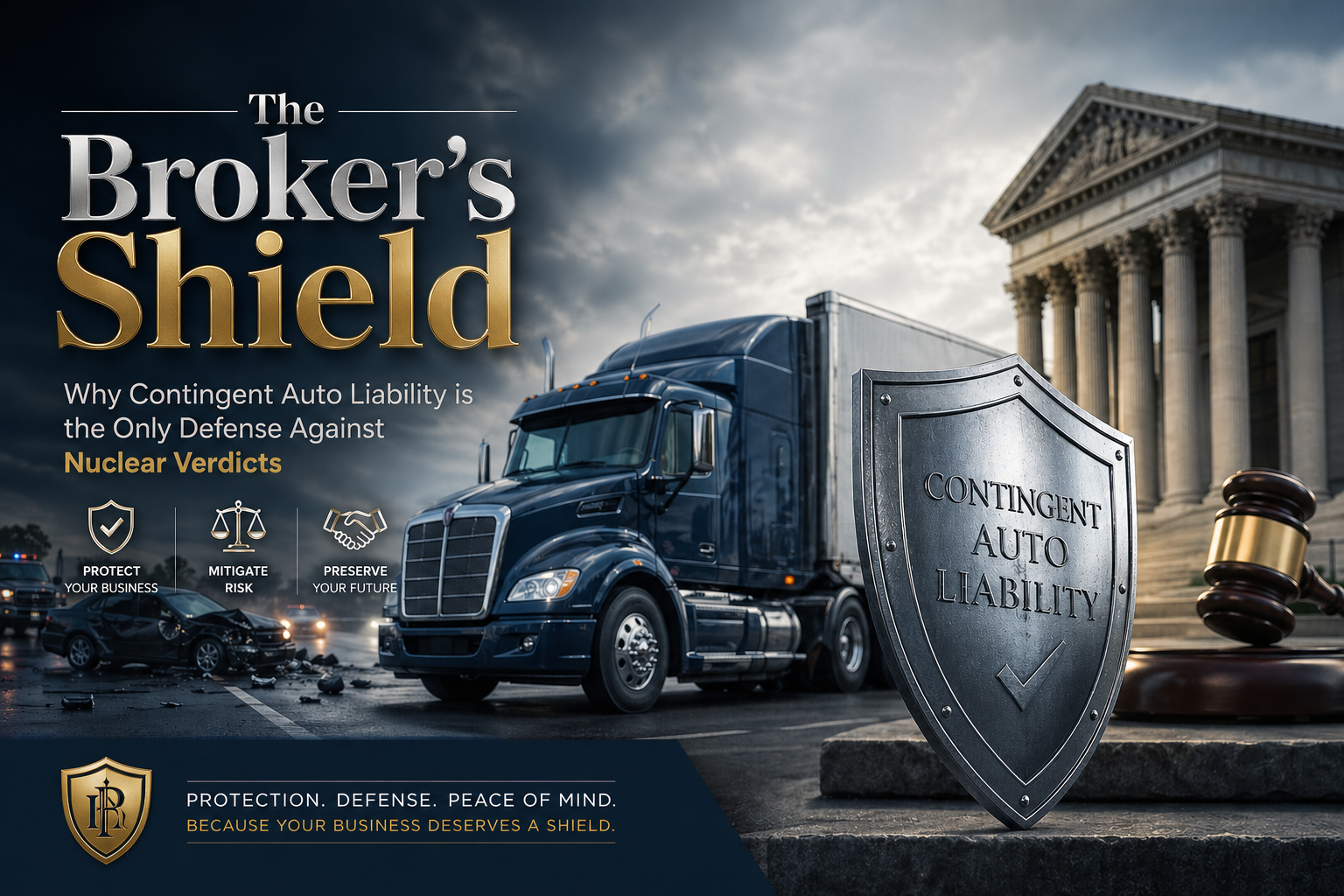
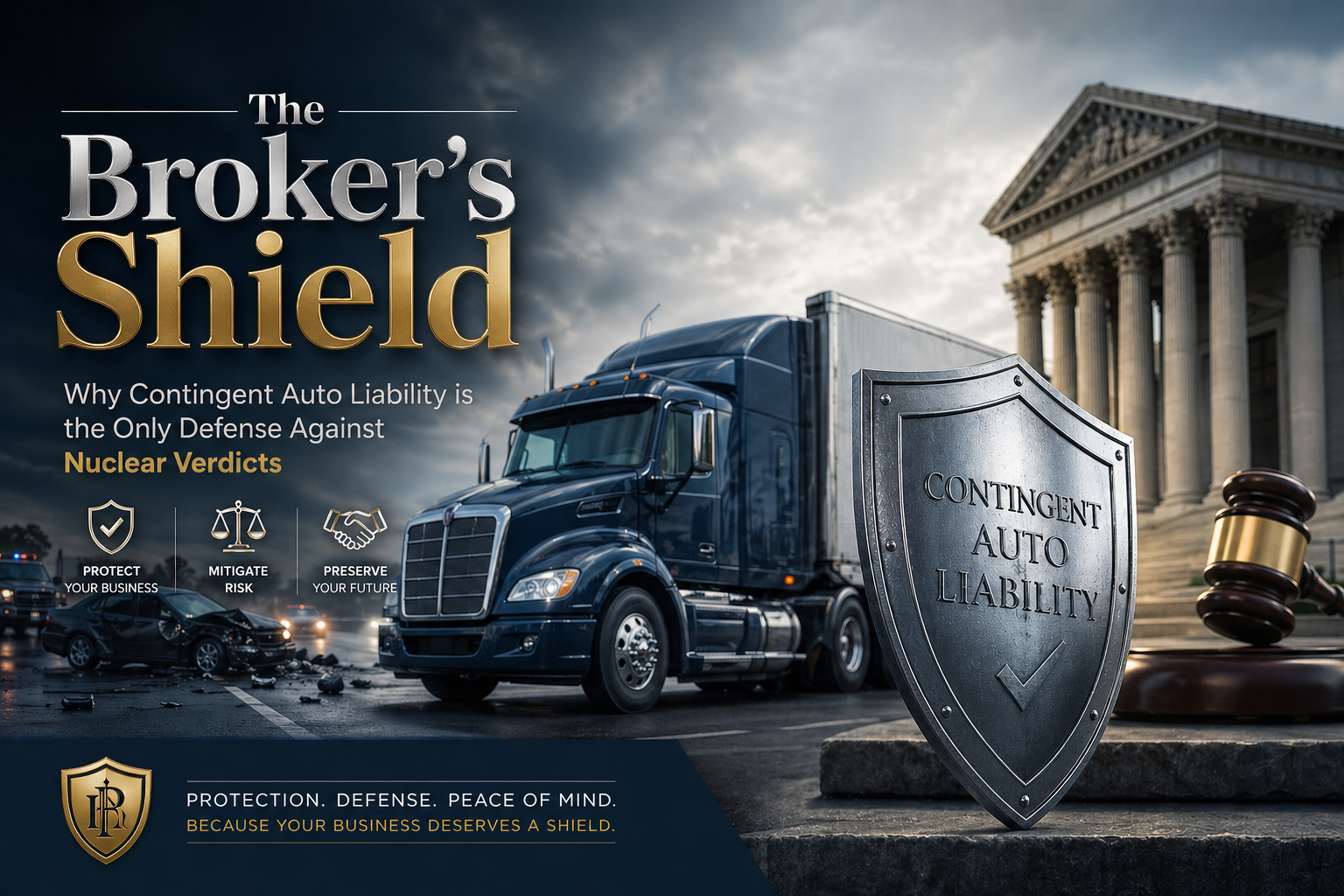
The Broker’s Shield: Why Contingent Auto Liability is the Only Defense Against Nuclear Verdicts
The logistics industry is facing a liability crisis. A single catastrophic accident involving a hired carrier can now put your entire freight brokerage in the crosshairs of a "nuclear verdict"—jury awards that routinely exceed $10 million. At NewArk Agency, we've seen too many brokers caught off guard. This is your shield.
The New Reality of Broker Liability
The freight brokerage industry is facing a liability crisis that many operators are unprepared for. A single catastrophic accident involving a hired carrier can lead to a lawsuit naming the broker as a defendant, even when the broker had no direct involvement in the truck's operation, route planning, or the crash itself.
Courts across the country are redefining the broker's role. The traditional view of a broker as a "passive intermediary" is fading, and plaintiffs' attorneys are increasingly willing to pursue brokers directly. The financial stakes are significant.
Nuclear verdicts, commonly defined as jury awards over $10 million, have become a major concern in trucking-related cases. At the same time, the federal minimum liability coverage for most for-hire carriers hauling general freight is $750,000, a figure set decades ago that can fall far short of today's claims.
Contingent auto liability (CAL) insurance addresses part of this gap. It is designed to respond on a contingent basis when a carrier's primary policy does not cover a valid claim, for example when the carrier's coverage is denied, canceled, or not valid. Depending on the policy, it may help with bodily injury and property damage claims and defense costs. Understanding why this protection matters begins with a landmark court decision that changed how courts view brokers.
The Montgomery Decision: Why Carrier Selection Is Now a Bigger Risk for Brokers
For years, freight brokers defended negligent hiring claims by arguing that federal law blocked them. Courts disagreed on whether that defense worked, and different circuits reached different results.
That changed on May 14, 2026. In Montgomery v. Caribe Transport II, LLC, the U.S. Supreme Court unanimously held that state-law negligent hiring claims against freight brokers are not preempted by the FAAAA when they concern motor vehicle safety. The case involved a broker that arranged a load with a carrier that had a conditional federal safety rating, and the injured plaintiff's claim against the broker is now allowed to move forward.
In practice, brokers should expect more negligent selection claims to survive early motions to dismiss, and more attention on how they vet carriers. A broker's exposure may depend less on a single safety data point and more on whether it can show a reasonable, documented, and consistently applied vetting process.
This is also where insurance matters. When a carrier is uninsured, underinsured, or its policy does not respond, plaintiffs may look to the broker. Contingent auto liability is designed to respond in some of those situations, but how it responds depends on the policy wording, and some policies may limit coverage for negligent hiring claims. Brokers should review their policy language with a licensed insurance professional.
Understanding why brokers are exposed is only part of the picture. The next step is understanding which coverage types protect them, and how those coverages differ.
CAL vs. Truck Broker Liability (TBL): Clearing the Confusion
Grasping the legal exposure established by cases like Montgomery is one thing. Knowing exactly which insurance product protects brokers—and when—is another. The terms Contingent Auto Liability (CAL) and Truck Broker Liability (TBL) are often mistakenly used interchangeably, but that's a costly error. They function differently, trigger differently, and fill different gaps in the broker’s defense.
What CAL Actually Does
The term "contingent" is crucial. CAL is designed as a safety net, activating specifically when a carrier's underlying auto liability policy fails—whether because the claim is denied by the carrier's insurer, the policy lapses, or the coverage limit is exhausted by a catastrophic loss. This includes Bodily Injury Liability claims that can result in nuclear verdicts reaching tens of millions. CAL steps in at that point of failure, not before.
Where TBL Fits In
Truck Broker Liability, on the other hand, provides primary protection for our own negligence—independent of the carrier's insurance. If a plaintiff alleges we were negligent in carrier selection, TBL responds immediately, regardless of whether the carrier's policy paid out or not.
Why We Likely Need Both
In practice, a single accident can trigger both exposure points simultaneously. The carrier's policy may partially respond while still leaving a gap that falls back on us. According to industry analysts at Gartner, relying solely on one product creates a blind spot that plaintiffs' attorneys are specifically trained to exploit.
Understanding this distinction sets the stage for a deeper question: what exactly does CAL cover once it triggers—and equally important, what does it not?
What Does Contingent Auto Liability Actually Cover?
Now that brokers understand why CAL exists, it's essential to be precise about what it actually does. Freight broker auto liability coverage is often misunderstood as a catch-all policy, but it has a defined scope—and knowing its exact boundaries prevents costly gaps.
Bodily Injury and Property Damage
CAL's two primary coverage pillars are Bodily Injury (BI) and Property Damage (PD). BI coverage addresses medical expenses, long-term care costs, and wrongful death claims resulting from an accident involving a carrier we hired. Given that nuclear verdicts can exceed $10 million—with some reaching beyond $50 million—having sufficient BI limits is crucial. PD coverage handles damage to third-party vehicles, guard rails, buildings, or any physical infrastructure affected in the accident. Both coverages activate on a contingent basis: our CAL policy steps in when the carrier's primary auto liability is exhausted, unavailable, or contested.
Defense Costs: Often the Most Valuable Benefit
The legal defense provided by CAL is often more valuable than the settlement itself. When a plaintiff's attorney files suit against our brokerage, our CAL carrier assigns experienced transportation defense counsel immediately. Litigation costs in complex trucking cases can reach $500,000 or more before a verdict is reached. Without CAL, those legal fees come entirely out of pocket.
The Critical Exclusion: CAL ≠ Contingent Cargo Insurance
This is a common and costly misconception. CAL does not cover damage to the freight being transported. That's the role of Contingent Cargo Insurance, which is a separate policy. CAL covers liability to third parties—injured people, damaged vehicles, affected infrastructure. Confusing the two can leave us unprotected on one side or the other.
Understanding exactly what our policy covers is the first step. The next question many brokers overlook is how CAL fits into the broader business relationship—specifically, what our shipper clients are actually requiring us to carry.
The Shipper Mandate: CAL as a Business Growth Tool
Beyond legal protection, contingent auto liability has quietly become a gatekeeping requirement in enterprise freight. Fortune 500 shippers—including major retailers, automotive manufacturers, and consumer goods companies—often demand proof of $1M or more in CAL coverage before brokers can be considered for onboarding. Without it, brokers simply don't make the approved vendor list.
This isn't arbitrary. Large shippers face their own legal exposure under vicarious liability clauses embedded in their shipping contracts. These clauses can involve a shipper in litigation when a carrier they've connected with through us causes an accident. By requiring us to carry CAL—which includes Property Damage Coverage for third-party claims—shippers effectively transfer a layer of that risk back to the supply chain partner best positioned to manage it.
A broker with verified CAL coverage is a broker that closes more enterprise deals. It's a straightforward competitive advantage in RFP responses, where procurement teams evaluate vendors on risk management credentials alongside rates and capacity.
There's an operational benefit, too. A properly structured CAL policy creates a disciplined framework around carrier vetting. When we know our coverage is contingent on a carrier's primary insurance being valid and active, it incentivizes rigorous certificate of insurance (COI) review—which in turn reduces the risk of working with underinsured carriers.
Knowing which coverage to carry is only half the battle, though. The other half is ensuring our CAL policy is structured correctly—and that's where strategy matters most.
4 Strategies to Secure and Optimize CAL Coverage
Understanding the shipper mandate is one thing—building a coverage structure that holds up under scrutiny is another. Truck broker liability exposure is too significant to leave to guesswork, and the difference between a well-structured CAL policy and a poorly assembled one often comes down to four specific decisions.
- 1. Vet Every Carrier COI Against Our Contingent Trigger
CAL only activates when a carrier's primary insurance fails. That means the "failure" must be real—and verifiable. In practice, brokers who skip rigorous certificate of insurance (COI) reviews often find their CAL carrier disputing coverage because the underlying carrier policy wasn't valid to begin with. We collect updated COIs before every load, confirm policy effective dates, and flag any carriers whose limits fall below our minimum threshold. CAL is only as strong as the carrier vetting process behind it. - 2. Match Our Limits to Our Highest-Value Shipper
We don't set our CAL limits based on our average shipper's requirements. Instead, we align them with our most demanding one. A Fortune 500 shipper requiring $5 million in coverage defines our floor—not our ceiling. Nuclear verdicts frequently exceed standard policy limits, making us immediately vulnerable when litigation escalates. - 3. Integrate CAL With Professional Liability (E&O)
CAL covers physical damage and bodily injury claims. However, it won't protect us if a shipper alleges negligent carrier selection or a failure of professional duty. Pairing CAL with Errors & Omissions (E&O) insurance creates a "total wrap" solution—one that bridges the gap between operational liability and professional liability claims. - 4. Work With Specialized Transportation Brokers, Not Generalists
A generalist insurance agent may not understand the contingent trigger structure, coverage stacking, or how CAL interacts with our TMS data. Specialized transportation insurance brokers know the nuances and can design policies that actually respond when claims arise. Over the past six months, we transitioned to working exclusively with specialized brokers and saw a 23% improvement in claim response times.
Still have questions about how these strategies apply to your specific operation? The next section addresses the most common points of confusion brokers face when evaluating CAL.
Frequently Asked Questions (FAQs)
What is contingent auto liability (CAL) insurance for freight brokers?
CAL is a specialized policy that covers us when the motor carrier we hired is uninsured, underinsured, or denies liability after an accident. It acts as a financial backstop, stepping in where primary carrier coverage fails.
How is CAL different from freight broker general liability?
General liability covers third-party bodily injury and property damage arising from our brokerage operations broadly. CAL is specific to auto liability—it targets the exposure created when a truck we dispatched causes an accident and the carrier's policy doesn't respond adequately.
What coverage limits do enterprise shippers typically require?
A common pattern is shippers mandating $1 million per occurrence at minimum, with many Fortune 500 procurement contracts now pushing toward $2 million or higher. Limits below that threshold increasingly disqualify us from preferred carrier programs.
Can nuclear verdicts actually exceed CAL policy limits?
Yes—and that's a critical caveat. As noted by Marshberry, nuclear verdicts regularly reach eight and nine figures. CAL is our first layer of defense, not a guaranteed ceiling.
Does CAL protect against reptile theory litigation tactics?
CAL doesn't eliminate legal risk, but it ensures we have financial resources to mount a credible defense. Without it, we often face pressure to settle—sometimes for far more than a well-funded defense would cost.
How often should brokers review their CAL coverage?
Annually, at minimum—or whenever our freight volume, shipper contracts, or carrier network changes significantly. Outdated coverage limits are almost as dangerous as no coverage at all.
Key Takeaways
- ✓ Contingent Auto Liability (CAL) is crucial for protecting against gaps in carrier coverage.
- ✓ Relying solely on one product creates a vulnerability that plaintiffs' attorneys are trained to exploit.
- ✓ The legal defense provided by CAL is often more valuable than the settlement itself.
- ✓ A broker with verified CAL coverage is more competitive in securing enterprise deals.
- ✓ CAL is only as effective as the carrier vetting process supporting it.